Clip 1: United Daughters of the Confederacy: Grief as a Guiding Force
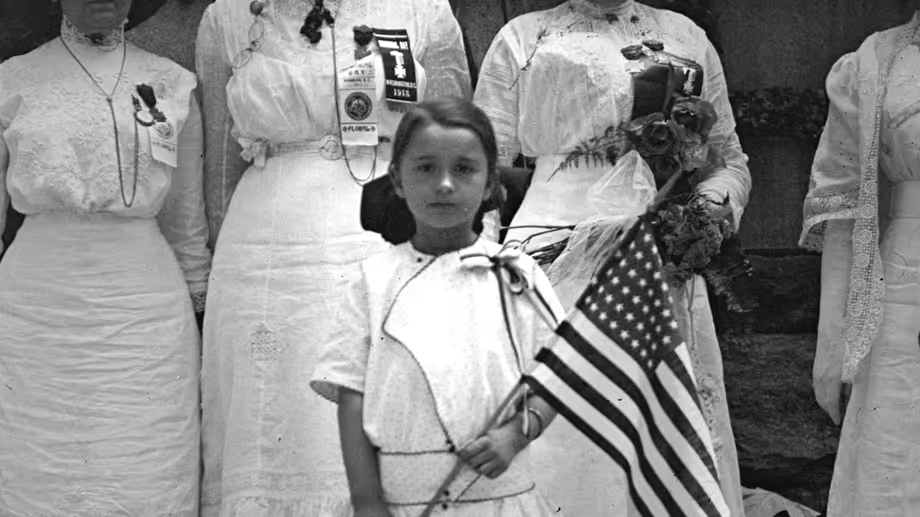
The United Daughters of the Confederacy waged a campaign to engrain the Lost Cause into public schools which lasted until the 1970’s. Rutherford’s “Measuring Rod to Test Text Books and Reference Books” was used to control how curriculum framed slavery. Additionally, the Daughters often dressed young school girls to represent a living Confederate flag at the unveiling of monuments. Their propaganda campaign rejected textbooks that acknowledged slavery as the cause of the Civil War, and solidified false histories of racial violence into curricula.
Clip 2: The Civil War Reenactment: Campfire Talk
During a Civil War reenactment at Camp Moore, CJ immerses himself in role play as a Confederate soldier, or “bad guy”, alongside Thomas Taylor and other attendees. While CJ, a former theatre kid and costume lover, describes the reenactment as “unexpectedly fun until, of course, you start talking about anything besides the costumes”. During a discussion about the CIvil War and its history and cause from the Confederate perspective, CJ is challenged for stating the truth and is accused of believing everything that he hears. CJ counters by referencing the wording of the Declaration of Causes.
Clip 3: The Lost Cause: Fiction as Historical Memory
While Thomas Taylor and CJ wrap up a conversation, we are shown historic imagery that depicts the loss of Confederate soldiers, the idea of the grief of the Confederacy, and the trauma that was imposed upon both the North and South. Here, we are introduced to a discussion featuring Christy Coleman and Karen Cox where the origins and fallacies of the Lost Cause are explored, and how the women of the White South’s need was to make their loss mean something. CJ narrates: “To find a meaning in a losing army that went all in on slavery... You’d have to write, like, a whole new story. And, that is exactly what White Southerners did. The story they invented after the War is called The Lost Cause”. The narrative is offset by juxtaposing movie clips celebrating the gallant south with stark images of brutalized enslaved men.
Clip 4: Charlottesville: Waving Hate
CJ travels with his photographer friend Abdul Aziz to document the infamous protests surrounding the removal of a Confederate Monument in Charlottesville, Virginia. Upon arrival, CJ and Aziz, while recording and documenting photos, find themselves amidst a gang of White men shouting “You will not replace us… Blood and sword!” and marching with tiki-torches. Though CJ describes the event to be “terrifying”, he and Aziz plan to continue to document these mobs. The next day, CJ and Aziz document opposition to the White Nationalist rally. As they leave Charlottesville, a distraught CJ reflects on the tragedy of the day, noting that a person was killed during the riot.
CJ reflects on ways that history can sometimes leave out the parts of the slave narrative that are empowering, and how that piece is missing from himself. He joins a slavery rebellion reenactment where an uprising of black men and women fought for their freedom in what is now known as St. John the Baptist, Louisiana. At this reenactment, Dread Scott, the organizer, explains that this event is a difficult performance that is deeply engaged with the ideas of Revolt of 1811 and radical freedom. Throughout the clip, this sentiment is shown through clips of the reenactment. CJ later explores the impact that participating in the reenactment has had on his journey to self-discovery.
Sources
Authored by:
Ahmariah Jackson
Ahmariah Jackson is the Griot, nestled somewhere between the raucous ideology of Gil Scott Heron and the subtle subversion of James Baldwin. Words are his sword and shield. He views education as a noble revolution and values the holistic growth of students over any standardized assessment. He re-invented the poetry club and dubbed it “The Griot Circle” where he fosters empowerment through expression. He is an emcee and a devotee of Hip Hop as culture, movement and music and folds all his passions into his classroom.
Cora Davis
Cora Davis is a former militant, angry protester turned reconciler. Her life has been transformed by the principles of nonviolence that are the foundation of how she lives and interacts with others. She teaches middle school students that their voices matter by fighting for her own and she has created an effective after school (and weekend and lunch hour and anytime) club for the “at risk” students otherwise falling through the cracks of the system. She believes a willingness to look at ourselves first is the key to bringing unity to the hurting world around her and is now convinced we cannot fight hate if it is in us, no matter how justified it is.